Postdoc Projects:
[1] Crystallographical design of electrodes for highly reversible electro-plating/stripping in grid-scale aqueous batteries, advisors: Dr. Yi Cui and Dr. Steven Chu
Contributions:
- Electrodeposition Process Development: Successfully developed a controlled epitaxial electrodeposition method to grow single-crystal metal on a single-crystal anode in an aqueous electrolyte, optimizing deposition parameters such as pH, ion concentration, and applied potential.
- Electrochemical Characterization: Conducted cyclic voltammetry (CV), chronoamperometry, and electrochemical impedance spectroscopy (EIS) to analyze the deposition kinetics, phase purity, and interfacial properties of the epitaxial layers.Structural & Morphological Analysis: Performed X-ray diffraction (XRD), scanning electron microscopy (SEM), and atomic force microscopy (AFM) to confirm crystallinity, film uniformity, and defect formation mechanisms.
- Battery Integration & Performance Testing: Explored the application of epitaxial metal electrodes in aqueous battery systems, investigating their electrochemical cycling stability, charge transfer kinetics, and potential advantages over polycrystalline counterparts.
- Mechanistic Insights & Theoretical Modeling: Assisted in developing a nucleation and growth model to explain the role of epitaxial interfaces in enhancing metal deposition uniformity and reducing dendrite formation.
Related papers: Nano Letters
Ph.D. projects:
[1] Spectrally engineered radiative cooling textiles, advisor: Dr. Po-Chun Hsu (UChicago)
Contribution:
- Material Selection & Fabrication: Assisted in identifying suitable polymer compositions and fabrication techniques to achieve broadband mid-infrared (MIR) emissivity while maintaining visible transparency and wearability.
- Optical & Thermal Characterization: Conducted spectroscopic and thermal measurements to validate the textiles’ radiative cooling performance under various environmental conditions.
- Heat Transfer Modeling: Developed computational models to simulate heat dissipation and cooling efficiency in real-world scenarios.
- Experimental Validation: Led or assisted in outdoor field tests to demonstrate passive cooling capabilities compared to conventional fabrics.
Related papers: Science
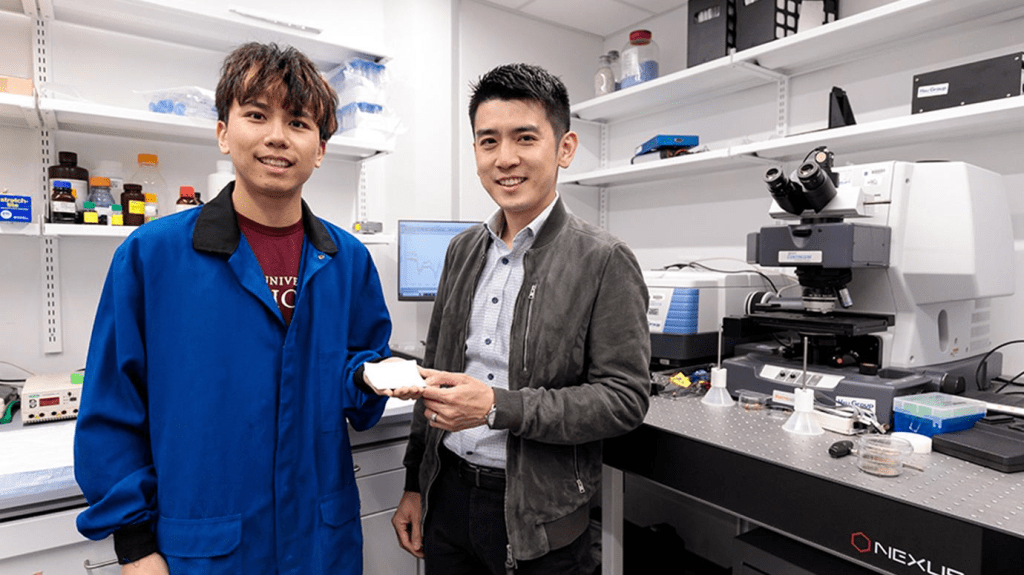
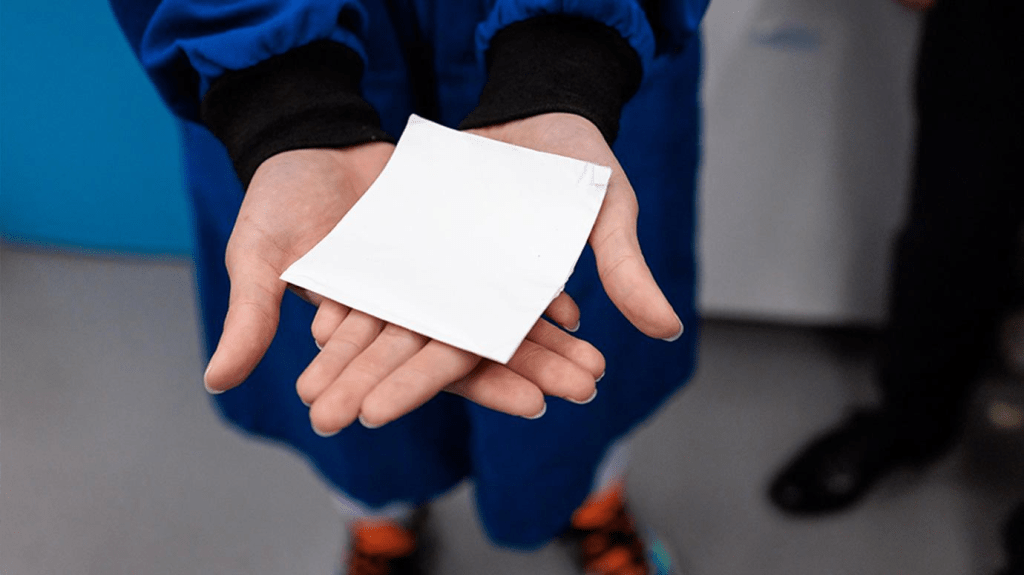

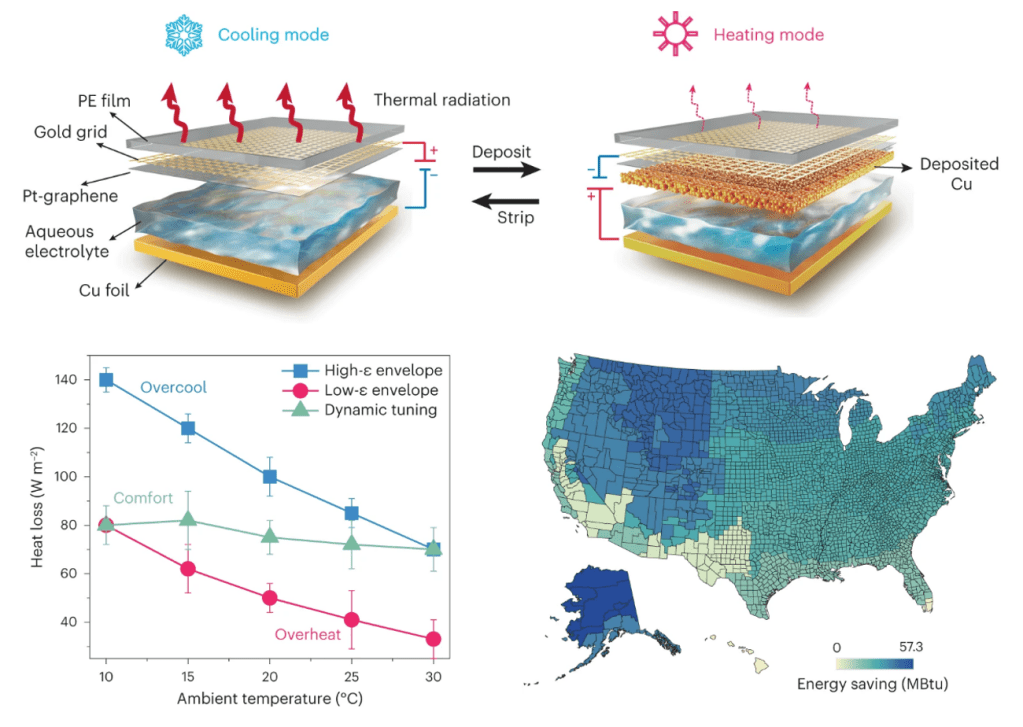
[2] Adaptive solar heater and radiative cooler (ASHARC) for all-season thermoregulation, advisor: Dr. Po-Chun Hsu (UChicago)
Contribution:
- Design and fabricate the ultra-wideband transparent conductive electrode with polyethylene film, monolayer graphene and photolithographed gold microgrid.
- Study the fundamental electrochemistry of reversible metal electrodeposition and design the proper electrolyte.
- Use in-depth characterization tools (SEM, TEM, XPS and XRD) to reveal the morphology of the deposited metals on graphene, which deepens the understanding on the electrodeposition and optical tuning.
- Fabricate a electrochromic device that can reversibly tune the solar and mid-IR optical properties with the largest contrast in the field for thermoregulation.
- Design and build an indoor environmental chamber and an outdoor radiative cooling and solar heating power measurement system by PID-controlled Peltier device and home-made thermal insulation.
- Established a rigorous computational approach in finite element method to investigate optical properties of the deposited metal nanostructures.
Related papers: Nature Sustainability, ACS Energy Letters, Nature Communication
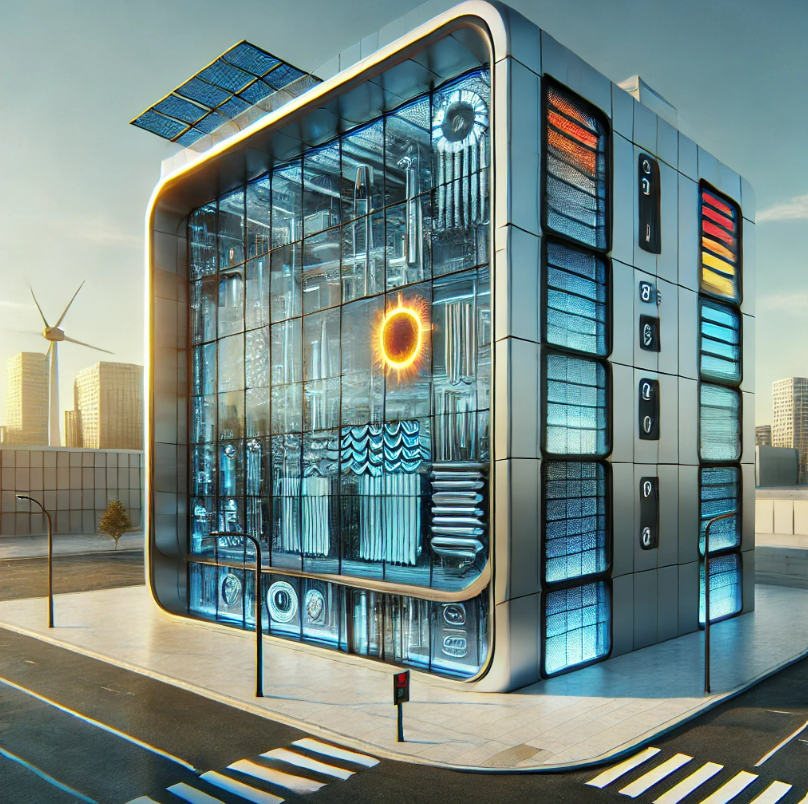

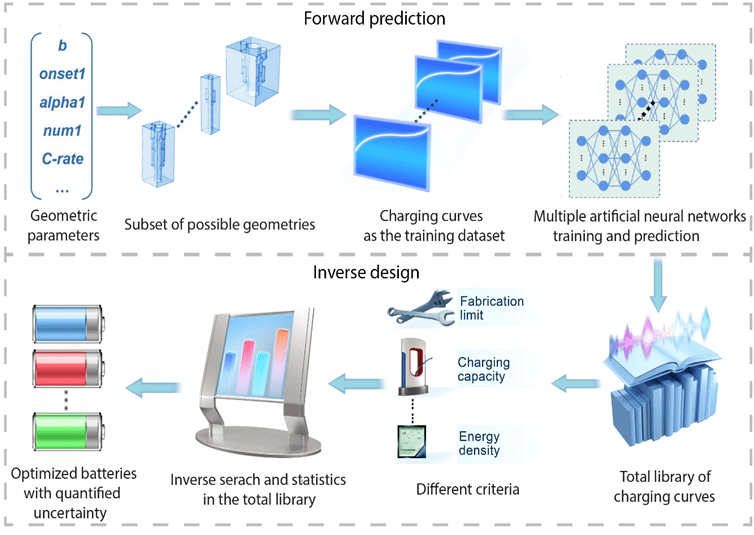
[3] Deep learning assist computational design of vascularized fast charging batteries, advisor: Dr. Po-Chun Hsu (UChicago)
Contributions:
- Theoretically derived the current distribution and tortuosity of the porous electrode by solving the Nernst-Planck equation and using the equivalent circuit theory.
- Building up a finite element model for vascularized battery with massive geometric and electrochemical parameters cluster sweeping.
- Demonstrated the deep-learning-assisted forward prediction and inverse design of the optimal electrode porous structure under different practical scenarios (max capacity, energy density, power density …).
Related papers: Advanced Energy Materials
Collaborative project:
[1] A scalable microstructure photonic coating fabricated by roll-to-roll “defects” for daytime sub-ambient passive radiation cooling, with Prof. Jong Eun Ryu (NCSU)
Contribution: Outdoor radiative cooling power measurement and building energy saving numerical simulation.
[2] Continuous, Nondestructive Detection of Microorganism Growth at Buried Interfaces with Vascularized Polymers, with Prof. Caitlin Howell (U. of Maine)
Contribution: Finite element study on the transport of nutrients in the vascularized channels.
Related papers: ACS Applied Bio Materials
[3] 1D photonic design by needle optimization algorithm of porous dielectrics for radiative cooling, with Elena Shevchenko (Argonne National Lab)
Undergraduate research:
[1] Variable thermal conductivity induced by the phase-transition of shape memory alloy for temperature-adaptive thermal switch, advisor: Dr. Bolin Liao (UCSB), 07/2018 – 09/2018
[2] Shape memory alloy for adaptive smart window, advisor: Dr. Bolin Liao (UCSB), 07/2018 – 09/2018
[3] Air-solid-liquid interfaced by gas diffusion electrode for efficient water-splitting reaction, advisor: Dr. Qu-Quan Wang (WHU), 01/2018 – 10/2018
Related papers: Nanoscale
[4] Numerical study of solar thermochemical water-splitting reaction enhanced by hydrogen permeation membrane, advisor: Dr. Xuejiao Hu (WHU), 05/2018 – 12/2018
Related papers: arXiv
 Chenxi Sui